

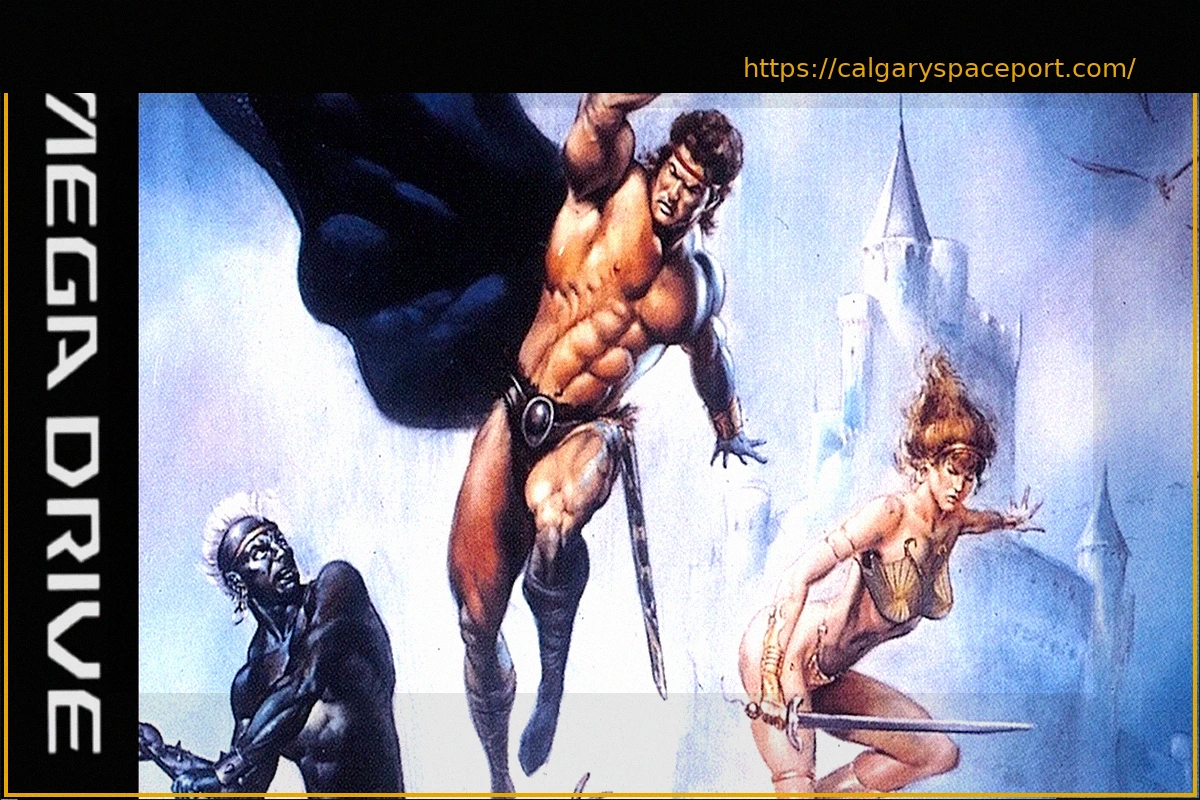
The hack-and-slash action game Sword of Sodan, first released on the Commodore Amiga 38 years ago, is often hailed as Denmark’s first significant video game. It was conceived and developed by three young Danes who collectively formed Discovery Software: Søren Grønbech (programmer), Torben Bakager (designer), and Julian Lefay (composer).
Sword of Sodan truly distinguished itself from other games of its era in numerous aspects, but its genuinely revolutionary visual presentation is arguably what the vast majority of players remember most vividly. While it might seem commonplace today, the game showcased enormous, meticulously animated, and well-designed character sprites. These characters frequently occupied between 50 to 80% of the screen’s height, a stark contrast to the smaller figures prevalent in other 1988 titles such as Contra, Super Mario Bros. 2, and Barbarian 2. This unprecedented scale contributed to a then-cinematic feel for the game.
Following its initial release on the Commodore Amiga, the game consistently maintained a spot in the top 10 sales charts for the subsequent six months, selling approximately 55,000 copies. This was an impressive achievement, especially for a game available on a single platform. The title also garnered the ‘Arcade Game of the Year’ award at the ‘1988 Software Oscar’ presented by Commodore Magazine, underscoring its profound commercial and critical success.
Grønbech and Bakager later revealed in an interview that despite receiving salaries from their publisher, Innerprise Software, during the game’s development, they never saw the percentage of sales that had been promised to them. Consequently, they did not fully reap the financial benefits of the game’s considerable success.
Two years later, the rights to Sword of Sodan were acquired by Innerprise Software in the United States, with the intention of porting the successful game to various platforms. This effort notably resulted in a heavily compromised version for the Sega Genesis. The game’s characteristic large sprites were significantly reduced (though still larger than in most other Genesis games, they were noticeably smaller than on the Amiga), the graphics were substantially downgraded, and several gameplay modifications were introduced. For instance, enemies now attacked from both sides of the screen (instead of only from the right or front), making the game incredibly difficult and often frustrating. Furthermore, the original 11 levels were cut down to 8, with some entirely removed and others combined to form new stages.
The Sega Genesis version, published by Electronic Arts in the US and Europe and by Sega in Japan, was widely lambasted by several magazines as one of the worst games ever created. The port was a complete failure, with numerous media outlets and player communities offering scathing critiques such as: “It sucked enormously. It was so bad that you can’t help but look at it and wonder why the developers thought for even a second that this could be at least a passable game, let alone a good one.” In 1993, the game was again ported by Bethesda Softworks to Apple Macintosh System 7 (also known as Mac OS 7). Verifiable information about this particular version is scarce, but it is said to have been more faithful to the Amiga edition, albeit with more limited sound capabilities.
During this period, Grønbech and Bakager transitioned into new professional ventures, as their experience with Sword of Sodan proved beneficial for their burgeoning careers. Bakager became a sought-after designer, undertaking various projects for different companies. Grønbech, among other roles, was involved in programming the on-screen mascot Hugo, a character some might remember from the early years of Danish TV2.
The third team member, Julian Lefay (born Benni Jensen), relocated to the United States and began working for Bethesda Softworks as a developer, eventually rising to chief engineer, responsible for all software development at the company. His extensive credits include titles such as Dragon’s Lair, The Elder Scrolls, The Terminator, and Wayne Gretzky Hockey. Tragically, Lefay passed away from cancer in the summer of 2025 at the age of 59.
After some time, Grønbech and Bakager, then in their mid-twenties, reunited to work on the anticipated sequel, Sword of Sodan 2. While it’s unclear if Lefay’s position at Bethesda in the US played a direct role, Bethesda Softworks indeed funded the game, intending to use it as a gateway into the Scandinavian market. As a result, Grønbech and Bakager remained in Denmark, rather than moving to the US, to develop Sword of Sodan 2. They established themselves in a villa in Brønshøj, near Copenhagen, to craft the follow-up to their big hit. Unfortunately, the game was never completed. Discovery Software eventually went bankrupt, and the saga of Sword of Sodan seemingly concluded.
Or so it seemed. After many years of silence, Sword of Sodan 2 was quietly announced last autumn by the Italian studio Smallthing Studios, slated for release on consoles and PC. In an interview, the developers stated that they had purchased the rights to Sword of Sodan directly from Electronic Arts and were now developing “an official sequel to the 1988 original.”
Only a single screenshot of Sword of Sodan 2 has been released so far, and notably, the signature large characters are absent, along with the visual distinctiveness that made the original so unique. It appears more akin to a new version of Golden Axe than the Sword of Sodan many remember, though it is, of course, far too early to judge a game based on just one screenshot. There is currently no release date for Sword of Sodan 2.
Sword of Sodan likely stands as Denmark’s first major international success in the gaming industry. It was created by three young men from the Copenhagen area, all of whom worked on various other titles both before and after Sword of Sodan, including The Vikings (Commodore 64), Hybris (Amiga), Dragon’s Lair (PC), Arkanoid (Mac), The Elder Scrolls (PC), and several Hugo games. Since then, Denmark has seen numerous other successful gaming ventures, such as IO Interactive, Playdead, Ghost Ship Games, SYBO Games, Geometric Interactive, Triband, and many more. However, Discovery Software, operating from a house in Brønshøj, was undoubtedly among the pioneering forces.