

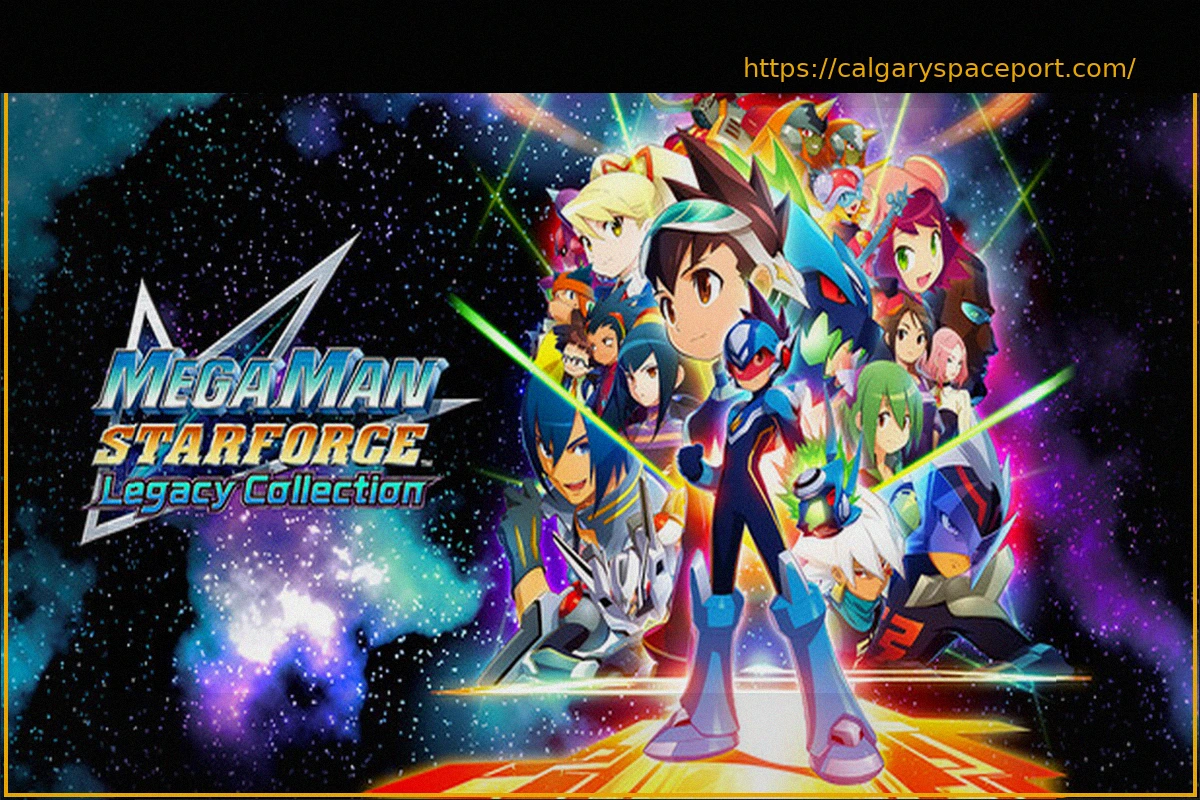
For most people, Mega Man evokes the main series that began on the NES, with a new game like Mega Man: Dual Override (or perhaps Mega Man X) anticipated next year. However, in Japan, Mega Man’s universe is much vaster, encompassing numerous lesser-known titles, many of which never made it to the West or at least didn’t gain widespread recognition.
Among the more significant and successful of these is the Mega Man Star Force series on Nintendo DS, considered a spiritual successor to Mega Man Battle Network (which also saw a Western release, primarily on Game Boy Advance). Star Force offers three distinct adventures spread across a total of seven different versions. This setup is comparable to Pokémon games, where selecting a version introduces subtle variations to your journey. However, lacking a major trading element, I’d argue it primarily served as a strategy to encourage players to buy multiple versions.
Fortunately, with the Mega Man Star Force Legacy Collection, you won’t need to make such a choice, as it includes all of them. Whether you prefer the aggressive Mega Man Star Force Leo or the connoisseur’s edition, Mega Man Star Force Dragon, both are available. Capcom has also enriched this collection with various historical extras from the games, such as the ability to view all cards, browse artwork, and listen to the in-game music.
The design remains strong, and the graphics hold up surprisingly well.
In essence, the Mega Man Star Force Legacy Collection provides a quite comprehensive package. Having only played the first game back in the day, I jumped straight back into it. Capcom opted to preserve the original graphic style, presenting a fully pixelated game. From the outset, I found the isometric style has remarkably withstood the test of time, maintaining admirable clarity.
The story centers on Geo Stellar, a young boy who has recently lost his father in space. While inherently a rather somber premise, it’s addressed very quickly, as was typical for games of that era. There’s little time for mourning; instead, characters and gameplay mechanics are introduced at a rapid pace. The first game is the most story-rich, dedicated to establishing the world. Besides Geo Stellar, we also meet Omega-Xis. These two pivotal characters in the series can fuse to become Mega Man, who then uses battle cards to defeat various enemies.
Graphics have been enhanced in several areas, notably with higher-resolution illustrations.
Games two and three follow a similar lighthearted presentation, with Geo Stellar and Omega-Xis still living with Geo’s mother, attending school, and residing in a small town somewhere in the future. A new troublemaker invariably emerges, kicking off a fresh adventure. There’s a surprising amount of dialogue, almost akin to an RPG, but because everything is concise and to the point, it never feels rigid or monotonous. It rarely feels deeply engaging, but rather serves as a quick justification for the unfolding adventure. If I had to draw a comparison, it would be to the storytelling style found in early Pokémon games.
The main draw of the Mega Man Star Force series was its card-based combat, presented with a PlayStation-like aesthetic (featuring improved resolution) on a smaller grid. Unlike the Battle Network series, Star Force leaned more into action and can actually be quite challenging. Fortunately, a range of helpful options is available, from frequent saving capabilities to extending battle timers or boosting weapon power.
Battles are the game’s highlights.
Battles unfold on a small grid, integrating both action and card mechanics. By effectively optimizing your battle cards, you can skillfully combine them to unleash massive attacks, all while firing your arm cannon and diligently avoiding enemy assaults. This creates a kind of dance between timing, positioning, and card selection that I find particularly appealing.
If I were to point out a negative, it’s that, as mentioned, these are Nintendo DS games, meaning the menus were originally designed for stylus input. I imagine this isn’t an issue on touchscreen devices, but having played it on the Xbox Series S/X (and indeed on PlayStation 5 as well), the menus felt a bit clunkier with a controller than they might have originally.
Menus can be a bit challenging to navigate with a controller.
Overall, this remains a very solid collection that’s easy to recommend. These are games that stand the test of time, wouldn’t necessarily have benefited from more polygons, and have been thoughtfully reworked with higher resolution where it truly matters (such as in battles and on the cards). If you’re seeking classic Mega Man action, this might not be for you. However, if you desire a typically ‘happy-go-lucky’ Japanese adventure paired with a deep gameplay system, then this excellent collection is genuinely easy to recommend.