

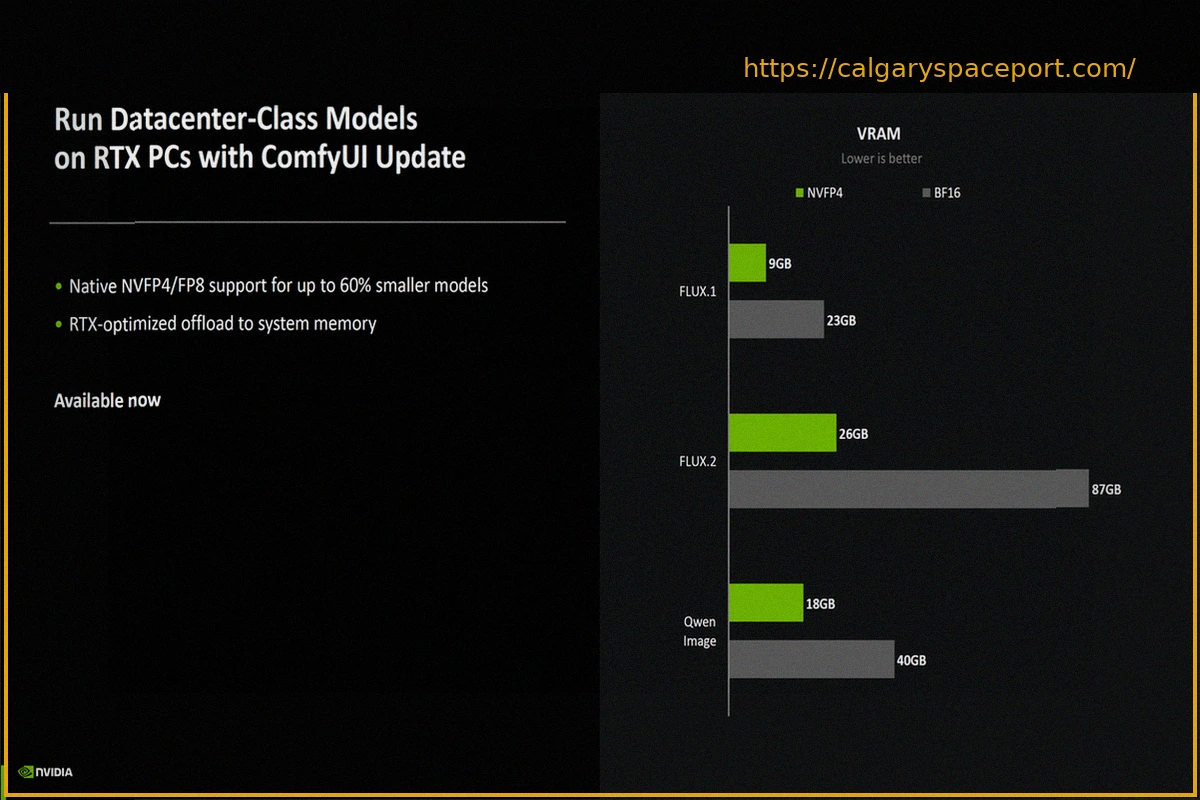
Nvidia has recently unveiled a significant breakthrough in its Neural Texture Compression (NTC) research, promising an impressive reduction in VRAM usage by up to 85% without any degradation in visual quality.
Acknowledging the increasing demands on VRAM, Nvidia attributes this trend to consumer expectations for highly photorealistic graphics in modern applications and games.
The technical paper elaborates on an innovative approach where textures are encoded rather than stored at their full resolution. This method leverages machine learning and neural networks to reconstruct images efficiently. A key benefit is the substantial reduction in texture size, with Nvidia demonstrating an extreme example where textures were compressed to just 1/24th of their original footprint.
A critical aspect of NTC is its deterministic nature; it avoids generative algorithms, ensuring that identical inputs consistently produce identical outputs. Since the neural encoding process is handled by the matrix engine, powered by Tensor Cores, the performance of standard CUDA cores will not be impacted. This implies that future generations of graphics cards, such as the upcoming RTX 50 series, should theoretically be able to support this technology once game developers begin to integrate it into their pipelines.